Building for a Hotter India
This year has made the trend hard to ignore. The monsoon reached Kerala late, the rain forecast is below normal again, and a strengthening El Niño is expected to keep temperatures up well into the winter. Through April and May, large parts of the country sat at 42 to 45°C, and on one day in late April every one of the world's fifty hottest cities was in India. This isn't a freak season any more. It's the direction things are moving.
The heat is only half the problem
India's air has also been getting more humid, with average relative humidity climbing several points over the last decade. That matters because humidity is what makes heat dangerous. When the air is already heavy, sweat stops evaporating and the body loses its main way of cooling itself. So we get the worst of both worlds: long dry spells that bake a building through, and then, when the rain finally arrives, a thick stickiness that makes the same temperature far harder to bear.
Why a bigger AC isn't the answer
The reflex is to buy a bigger air conditioner. We understand why, but it's a fragile fix. ACs push up electricity bills, lean on a grid that's already straining at peak summer, and stop working the moment the power goes. A home that needs a machine running to be livable is only ever as comfortable as its worst load-shedding afternoon.
Letting the building do the work
Our starting point is different. We think the building itself should do most of the work, the way homes did before air conditioning became the default. That means getting the basics right first: which way the rooms face, where the sun lands through the day, how to shade the walls that take the worst of it, and how to let a building breathe so warm air can leave and cooler air can come in. Much of this is old wisdom that quietly got dropped once cheap cooling made it feel optional. We think it's worth bringing back.
Walls that hold both the heat and the damp
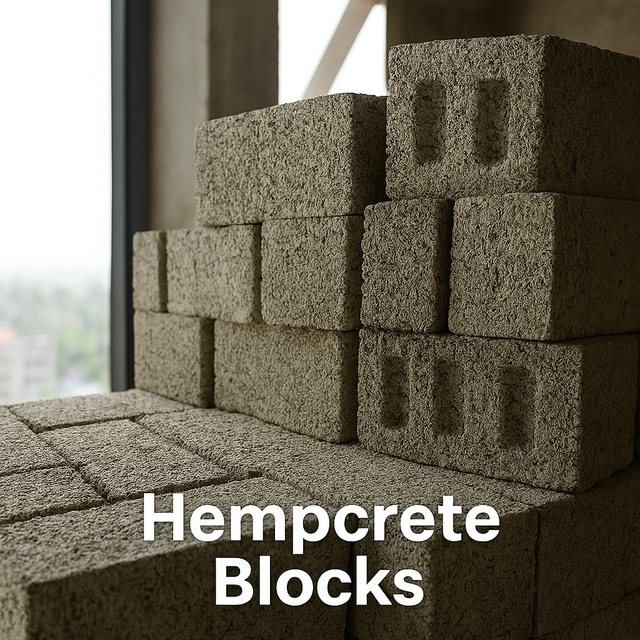
Then there are the walls, which is where we spend most of our time. Hempcrete, the hemp-and-lime material we build with, does two things an ordinary wall can't. It has the mass to take in the day's heat slowly and release it slowly, so indoor temperatures stay level instead of spiking every afternoon, and it breathes, pulling moisture out of the air when it's heavy and giving it back when it's dry. In our projects that has meant indoor humidity holding in a comfortable 40–60% band, temperature swings down to around a degree and a half, and cooling loads cut by close to half at the peak of summer. The wall ends up doing quietly what the AC was straining to do. There's more on how it compares with conventional blocks in hempcrete vs AAC blocks.
A healthier surface, too
On the surface we use our Bio-plaster, a natural hand-finished plaster of mineral powder, earth pigment and hemp. It keeps a wall breathable instead of sealing it behind plastic paint, and it carries none of the chemicals that ordinary coatings give off into the rooms you live in. A small part of the picture, but a healthier one.
What we're building for
We won't pretend a wall solves a climate crisis. What we can say is that the way we build makes a real difference to how a home holds up through a summer like this one, and to how hard it has to lean on machines and the grid to stay livable. That's the problem we're building for, and it isn't going away.
Is the heat on your mind for a project?
We design and build cooler, healthier spaces across India from our base in Kolkata. Let's talk through your home or space.
Talk to us